Worried About Data Centers and Water Use? Here’s What You Need to Know
Scroll
Data centers are in the news often lately. Seems like they are being built in many states, and especially in places close to environmentally sensitive parks or locations where the noise and water use will negatively impact both humans and animals. Our current administration is by-passing many of the regulations that were previously in place to review sites before any action. People are alarmed about the water needed to run data centers, especially in places that are already prone to droughts and water shortages.
I say this as gently as possible, because most people have an instant knee jerk reaction against this information. (There’s a 100% chance I’ll lose subscribers after publishing this post. If this is you, maybe look honestly at why that is–why does me telling you the facts about what is going on bother you? ) But if we really want to talk about water use, we MUST talk about animal agriculture.
The simple fact is that you cannot call yourself an environmentalist, claim to care about the future of our planet, or complain about data center water usage if you’re not willing to look at the facts–especially those showing that there are other industries using A LOT more water than data centers.
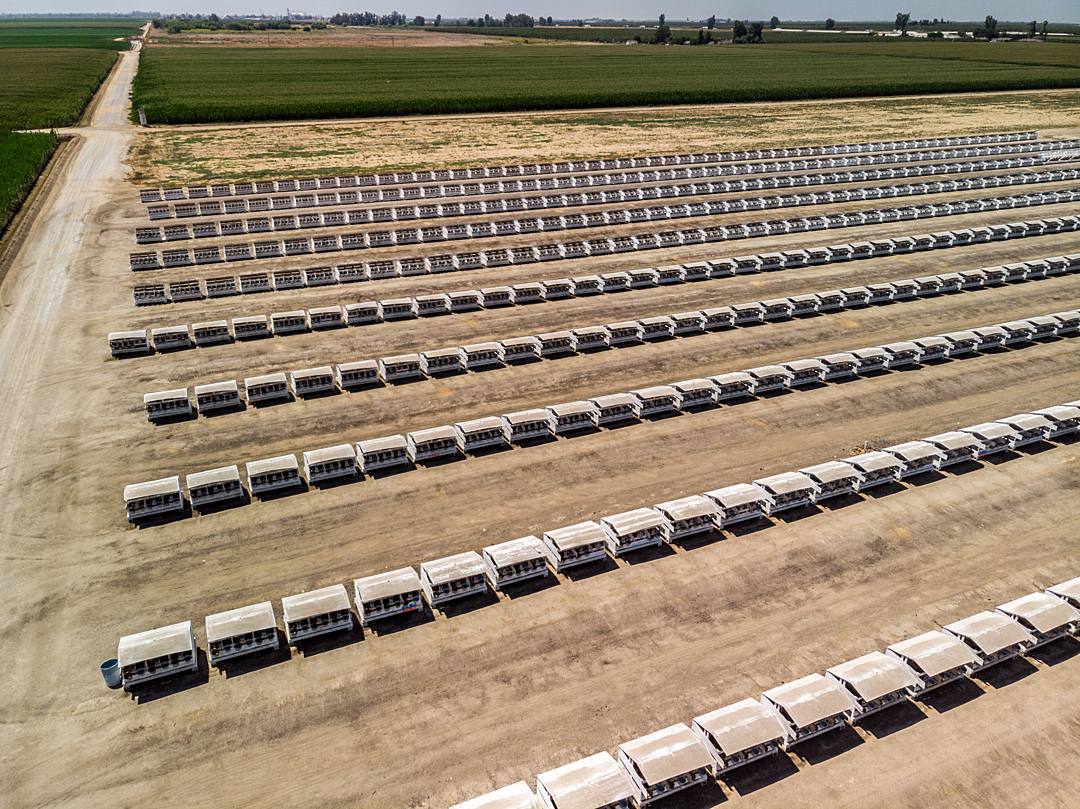
With a population of over 1.7 million dairy cows, California has the largest population of dairy cows in the United States, responsible for 18% of the country’s entire dairy production. Over the course of four days, during the month of July 2023, and for two days in August 2023 our photojournalists accompanied a researcher from Animal Outlook to several farms in California to document the conditions cows and their calves endure. On some days during visits the temperature reached 109 degrees Fahrenheit (43 degrees Celsius) and they observed animals who appeared to be suffering from heat exposure, including cows gasping for air. Research has demonstrated that dairy cow mortality rates can increase by 27 percent during heat waves. Some of the farms visited had more than 3,600 calves. Inside the calf hutches, there was no space to turn their bodies, and the small enclosures appeared unable to accommodate the calve’s height.
Ecologist Nicholas Carter, an environmental science advisor for FoodFacts.org, has been making exactly that point. He recently highlighted a comparison that should have stopped a lot more people in their tracks. AI data centres are projected to use roughly 1 km³ of water a year by 2028. Livestock systems already consume around 228 km³ of freshwater every year. That means animal agriculture uses roughly 200 TIMES MORE WATER THAN DATA CENTERS. If those figures are even roughly right, and a peer-reviewed estimate says the livestock number is, then the scale difference is staggering.
Did you know “processing ONE POUND of beef uses 2,500 gallons of water, while it takes 477 gallons of water for eggs and nearly 900 gallons for cheese.” (from University of Colorado, Boulder) That’s the equivalent of a cow drinking around 53,700 glasses of water! Imagine how many pounds of beef are produced EVERY SINGLE DAY. And yet no one is complaining, or pointing out that water usage.
It’s not hard to figure out why this is. It’s always easier to blame someone else, (data centers!) rather than examine how our individual choices could make a difference, especially since those choices would require changing what we’ve been doing our entire lives! Talk about inconvenient.
Science has proven again and again that consuming animal products, including milk, eggs and animal flesh, is not necessary to live a happy and healthy life. Does it make sense to you that we are able to feed 80 BILLION land animals every single year, but can’t even feed 8 BILLION HUMANS that inhabit this planet? (We could if we stopped eating animal products and ate a plant-based diet.) Or that only 4% of mammals left on earth are wild animals? The rest are farmed animals and humans.
Does this make sense to you!?
Am I saying data centers are good and that we should all just look the other way and allow them everywhere? Definitely not! If one were built by me, I’m sure the noise alone would cause me to move, or go crazy. It’s heartbreaking to think of all the animals suddenly needing to adjust to the disturbing noise, or the humans who now can’t even step outside and enjoy the sounds of nature. How unfair that a few rich humans would subject them to this! But I am saying that if we are truly worried about water shortages on our lovely planet Earth, then we need to consider animal agriculture and all of its negative consequences.
Because maybe you don’t realize (I certainly didn’t before becoming vegan) that animal agriculture and fishing are one of the leading drivers of habitat loss, species extinction, biodiversity loss, water scarcity, water pollution, ocean dead zones, loss of indigenous people, antibiotic resistance, deforestation, algal blooms, and eutrophication.
Let’s start using FACTS to make informed choices –choices that we have the power to start TODAY. The demand for bacon, steak, chicken wings, ice cream, fish, lobster, shrimp, salmon, oysters, eggs, cheese, and other animal products is causing the destruction of our planet. This is FACT. When will we be brave enough to acknowledge that and make the necessary changes to make a difference? Even cutting down on your animal consumption makes a difference. It doesn’t have to be an all or nothing decision!
You can BE THE CHANGE, instead of a contributor to the problem.
Farm Sanctuary was co-founded by Gene Baur and Lorri Houston in 1986 when they rescued Hilda, their first sheep. It was the first sanctuary of its kind, focusing wholly on rescuing and advocating for animals farmed for food. As of 2021, Farm Sanctuary’s website states that its mission is “[To] pursue bold solutions to end animal agriculture and foster just and compassionate vegan living.” Today, they have sanctuaries in New York and California and at any given time are caring for almost 1,000 animals. The sanctuaries attract thousands of visitors, interns, and volunteers each year. The New York shelter boasts 275 acres of rolling pastures, forests, an education centre, and accommodation for guests, and the Southern California shelter has 26 acres. Educational events about animals are held at each sanctuary throughout the year..
The China Study: The Most Comprehensive Study of Nutrition Ever Conducted and the Startling Implications for Diet, Weight Loss, and Long-term Health by T. Colin Campbell. (This is a fat book! You can read a summary here)