
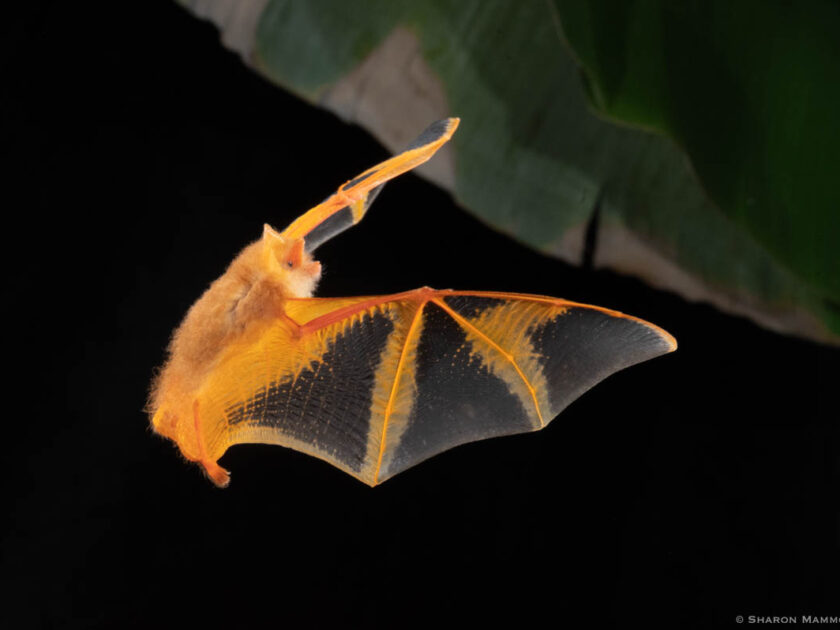
This past March I traveled to Thailand to meet up with bat biologists and photographers, Dr. Merlin Tuttle, from Austin, TX, and Daniel Hargreaves from the UK, and as well Merlin’s staff from Merlin Tuttle’s Bat Conservation,and a small group of self-professed ‘bat nerds” like me from around the world. While typical tourists visited beaches and temples, we spent our days exploring caves, bushwhacking through the jungle and farmer’s fields, and staying up late to watch these magnificent creatures of the night. For ten days we traveled the country in search of some of Thailand’s most interesting bats, including two species I have been wanting to see my entire life– the beautiful painted bat, (pictured above) and the world’s smallest bat– the bumblebee bat.
Painted Bats (Kerivoula picta)
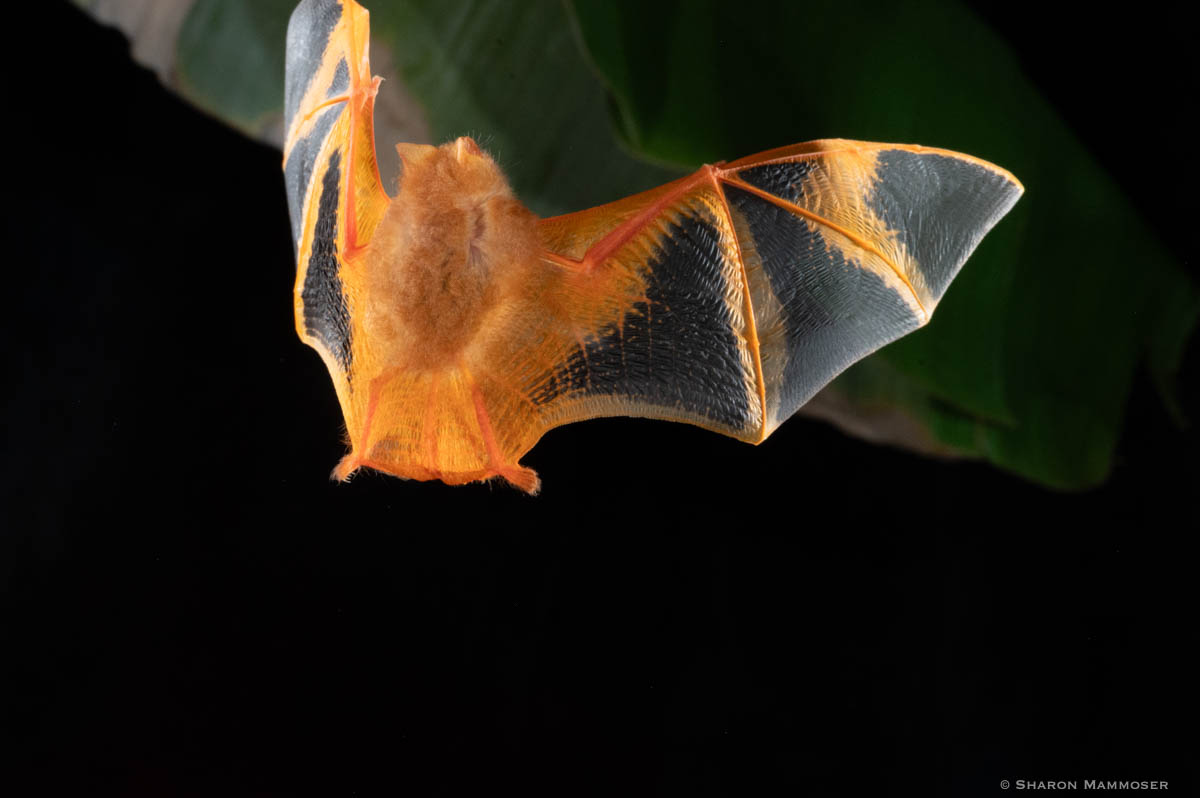
The painted bat is far from what most imagine a bat to look like and it doesn’t fit the idea people have about bats. It is a black and orange bat that give it its two common names, the butterfly bat, and the painted bat. It only weighs about 5 grams and has a wingspan of between 18-30 cm/7-11 inches. This bat doesn’t live in caves, and is mostly solitary, or found in a family group of two to three bats. They live in Thailand, India, Shi Lanka, and other Southern and SE Asian countries. Most people in these places have never seen this bat because of course it is active at night…and most people aren’t out at night looking for it.
Deforestation for agriculture is one of the main threats to this bat. A second threat is people killing them to sell to tourists–the bat’s beautiful wings stretched out and pinned beneath glass, in a frame like a butterfly. If tourists would stop buying these, the demand would disappear.
During the day these small bats roost in banana leaves, palm fronds or even under loose bark. Finding them is a bit like looking for a needle in a haystack, but luckily we had the help of a family who has been protecting this bat for 4 generations. Many volunteers went out with us as we combed the edges of farmer’s fields, looking under every banana plant leaf, gently without touching, sometimes looking for the small shape of a sleeping bat Painted bats love to roost at the edge of dried up leaves where they blend in perfectly. They can be found alone, or in a pair, sometimes with a single pup. We looked and looked, and then spotted a pair! All of us crowding in to peek under the leaf and see the sleeping bats–who were no longer sleeping, but instead, were watching us watch them. After taking turns carefully photographing them, we returned to the Peung family home where we gathered for dinner in their outdoor, but covered, dining area.
Later Merlin and some volunteers set up “his studio,” under the roof of the home, off to the side of the main table. This studio is a large mesh tent where Merlin will add natural plants and other materials from outside, staging it like the natural habitat of the bat. Then just before dark, someone returned to the banana leaf and borrowed a painted bat for us to photograph. I was lucky enough to be one of the photographers invited into the studio, my camera set up on a tripod with a cable release, ready for the action. Besides Merlin, who was directing everything, there were at least 4 of us photographers, positioned in front of the “set” and ready for the bat. Merlin released the bat, who proceeded to fly around in the small tent, never once hitting any of us, showing again and again how perfectly they can maneuver in darkness with a combination of their eyes (bats are not blind!) and their sophisticated sonar. When the bat flew over me I could hear and even feel his wingbeats above my head. It was a priceless experience, and worth the long flight to get to Thailand! In awe, we all watched as that painted bat flew around us all, navigating perfectly in the darkness. Me and the other photographers waited with great anticipation for the bat to fly through the infrared beam that would trip the flash and light up the gorgeous orange and black wings.
I may have pushed the button 200 times, hoping, but in reality, captured only 3 photos. Standing there in the dark, t’s impossible to know when the bat might fly through the beam so we all just continually pushed the shutter, leaving it open for a few seconds, before pushing it again. Hoping, hoping hoping. Photography is a game won only by patient and persistent people! I loved the experience of being in there with the flying bat and am especially grateful to have had it.
After our photography session, someone took the bat back to the field where we’d gotten him and released him… I would have loved to know what he told his friends about the experience!
Merlin sometimes trains the bats, in the same way someone would train a dog. We didn’t do this on our trip to Thailand, but I witnessed it a few years ago when my husband and I joined Merlin on another trip, this one to Panama. In Panama, Merlin also set up his studio, but since we were in the same place for the entire trip, Merlin was able to bring a bat into the studio and train him or her to come to his finger to get a food reward, usually a mealworm. Most people are shocked to learn bats are smart and can be trained! After a few days with Merlin, the borrowed bats learned that Merlin’s mouth making a clicking sound meant a free nibble of food, no effort needed! Then after being photographed, they were released where they were found.
Lyle’s Flying Foxes (Pteropus lylei)
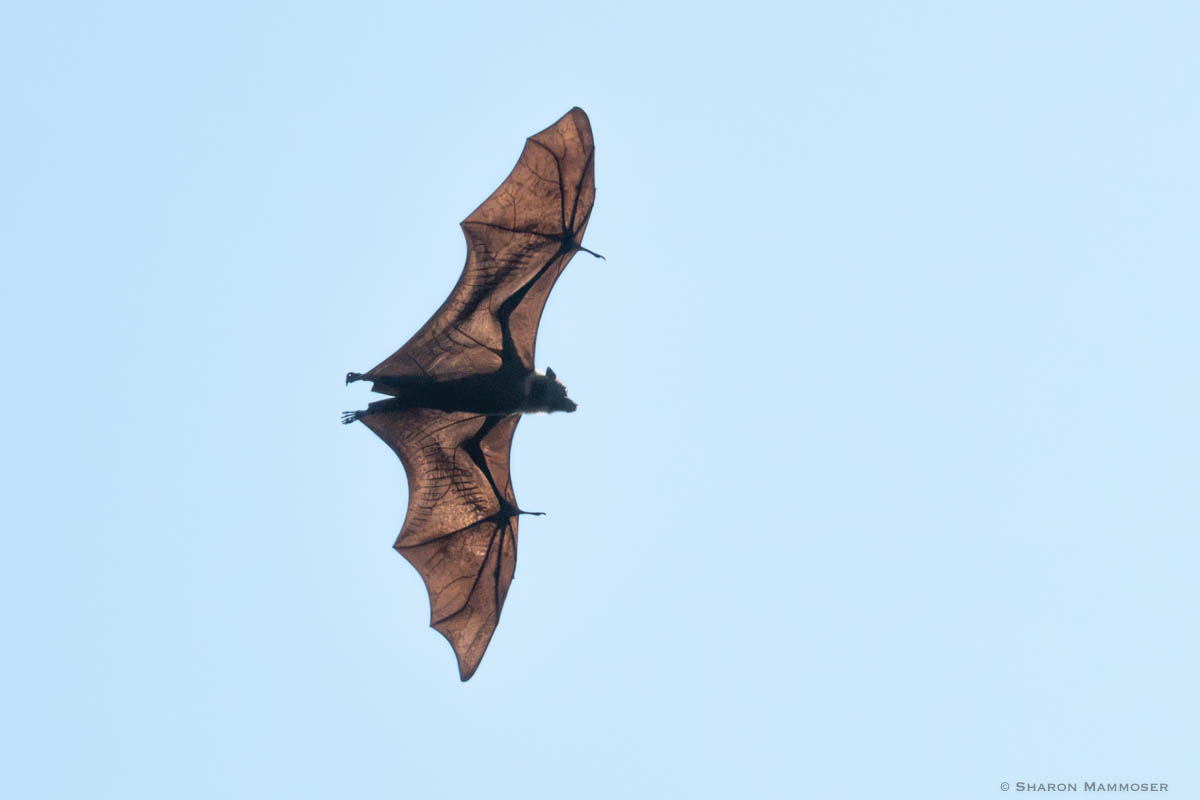
After visiting with the Peung family for several days we drove north to Ang-Thong Province where we had another amazing experience– spending the afternoon and evening watching a large colony (called a camp) of Lyle’s flying fox fruit bats. These bats are as cute as foxes, with giant brown eyes and fluffy orange fur on their upper back, chest and throat. Their wing membranes are dark brown. With a three foot wingspan they are an impressive sight, especially when they fly. During the day they hang from branches in trees on the grounds of a temple protected by the Buddhist Monks. As dusk approaches, the bats begin waking up, moving around, chatting loudly with their roosting mates, stretching their wings, and on this very hot day, fanning themselves to try and stay cool. We were able to walk among the trees, looking up in wonder at the bats above us. They definitely were aware of us and kept a close watch.
As darkness neared we witnessed an extraordinary “switching of the guards.” Dozens of white egrets flew in, arriving to the forest and finding places high in the trees to settle in for the night while the bats were doing just the opposite–readying themselves to head out and forage. The birds and the mammals get along fine, peacefully coexisting in this special place. Lyle’s flying foxes eat fruit, including mangos, cashew, monkey jack, dragonfruit, tamarind, and rose apple. They also drink nectar and eat flowers and pollen. These bats are important seed dispersers — some seeds pass through their digestive tract and come out the other end, falling to the ground in places far from where the bat fed.
There were many Mama bats with pups in the trees and if I looked closely I could watch the young ones nursing or being groomed by Mom. Mom bats will carry their pup with them while foraging.
The cacophony was exhilarating and it was hard to know where to look as darkness settled. Bats in the trees, in the sky, all squawking loudly, seemingly needing to tell everyone in earshot what was going on. It was wild!
I thought nothing could beat that experience… but then the next morning, at sunrise, we visited another Lyle’s flying fox camp– this one on the opposite side of a wide meandering river. As the sun cleared the horizon, the bats were returning to their roost in the trees. I was transfixed, reveling in the way the golden light made their wings glow as they sailed effortlessly through the sky above the river and settled into branches high in the canopy. Few natural history experiences in my life can compare to the joy and awe I felt watching the bats that morning.
Bumblebee Bat (Craseonycteris thonglongyai)
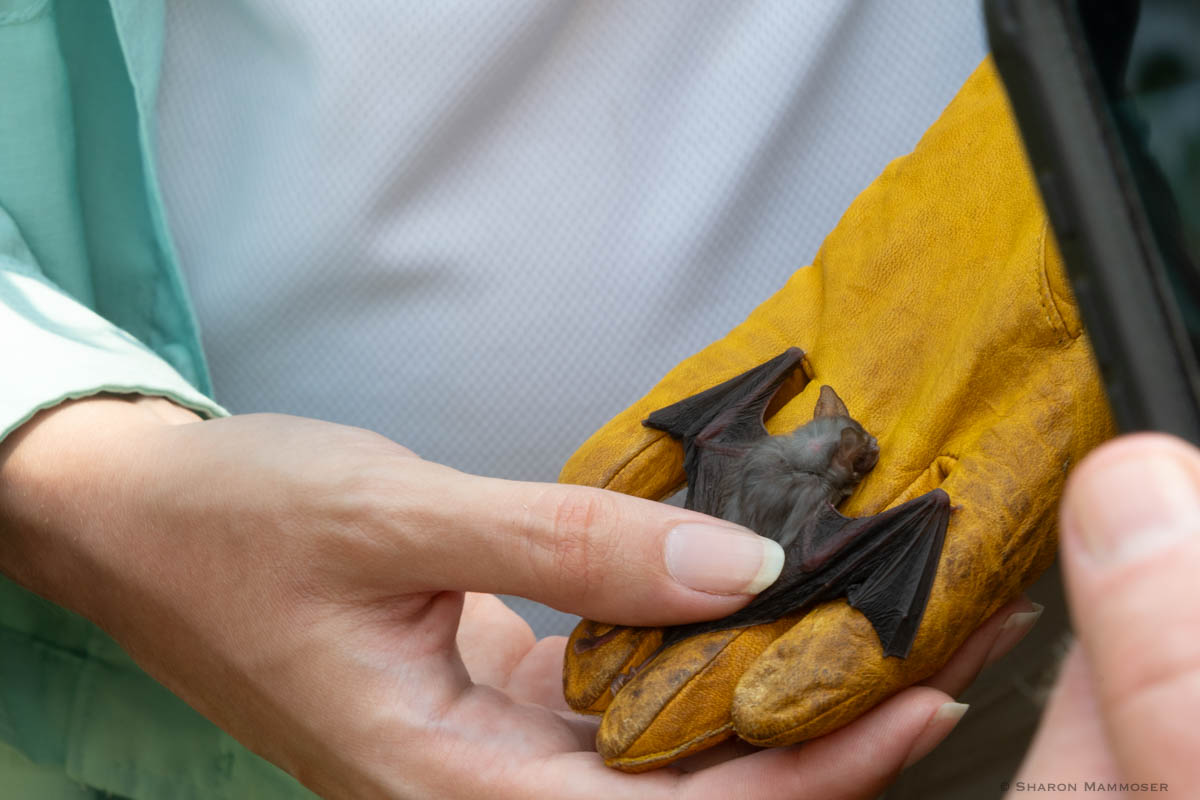
Next we traveled to Sai Yok National Park searching for the world’s smallest bat– the bumblebee bat, also called Kitti’s hog-nosed bat. Weighing less than dime at .071 ounces, and with a body length of 1.1-1.3 inches, this is a small creature! Only discovered in 1974 by Thai zoologist, Kitti Thonglongya, this bat lives in limestone caves along rivers. These small bats usually roost far from the cave entrance, by themselves, although there could be as many as 100 other bumblebee bats present in the cave.
We arrived at the first cave and dispersed to explore. Like many caves we visited, this one had a large Buddhist alter with a cement platform prayer area and many watching Buddha statues all around. Most tourists stopped to admire the Buddhas and look at the structure and size of the cave, but few noticed any of the winged mammals high above one the tan walls. Many different bat species occupy the caves, sometimes roosting together on the ceiling, or, like the bumblee bat bat, roosting alone in out of the way places. Soon one of the leaders returned holding a bumblee bat, bringing it close so we could all see and observe. This bat feeds on insects and spiders, grabbing them out of the air, or sometimes gleaning them from leaves. They have reddish brown to gray fur and a distinctive pig-like snout.
Throughout the next few days we visited a handful of caves, looking for bumble bee bats, but other species as well. The most notable experience was the day we traveled by boat–splitting the group into three and heading down the river. When we stopped it seemed like there had been some mistake as there was nothing visible but jungle and a steep bank. The guides pulled the boats onto shore and headed up the slope. We followed, heading into a dense thicket of green. Walking single file we curved our way through the dense trees, and then the rubber farm, and then more trees until we came to a small cave opening hidden on a hillside. A few of the guides disappeared inside while the rest of the group chatted with Merlin, who has no shortage of stories to share.
Some time later the guides emerged from the cave with another bumble bee bat, which we all looked at and admired before they returned it to her roost. They brought several other bat species out for us to look at before we bushwhacked back to the boats and returned to civilization. Did I mention that Merlin will be turning 85 in August? The guy doesn’t let his age stop him or even slow him down from doing what he wants and is a great example to us all at the importance of staying active!
Later that night we set up some mist nests in a field near where we were staying. We caught a handful of new species of bats, including some nectar drinking bats with super long tongues and cute mouse-like faces. I loved watching them drink sugar water from a spoon and then, after weighing, measuring them, I was allowed to let one go, which was super fun! I loved holding him and then letting him go to disappear into the night.
Wrinkle-lipped free-tailed Bats (Mops plicatus)
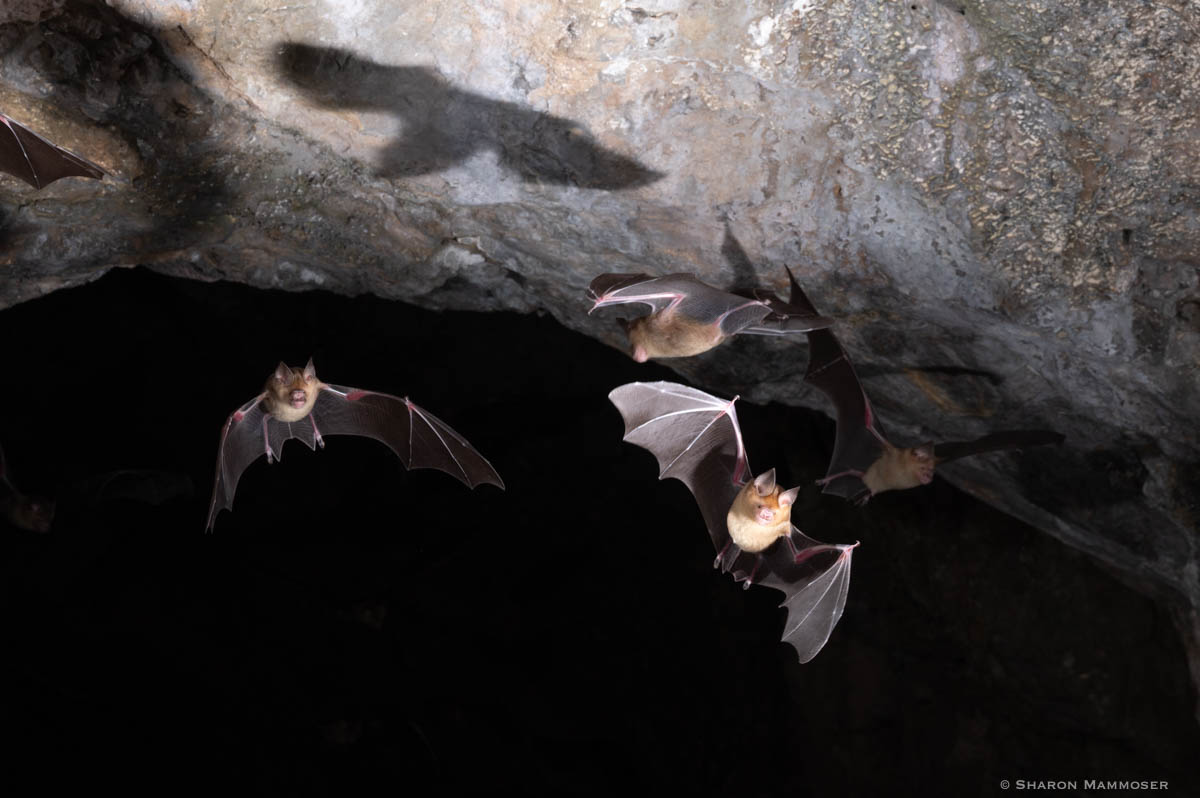
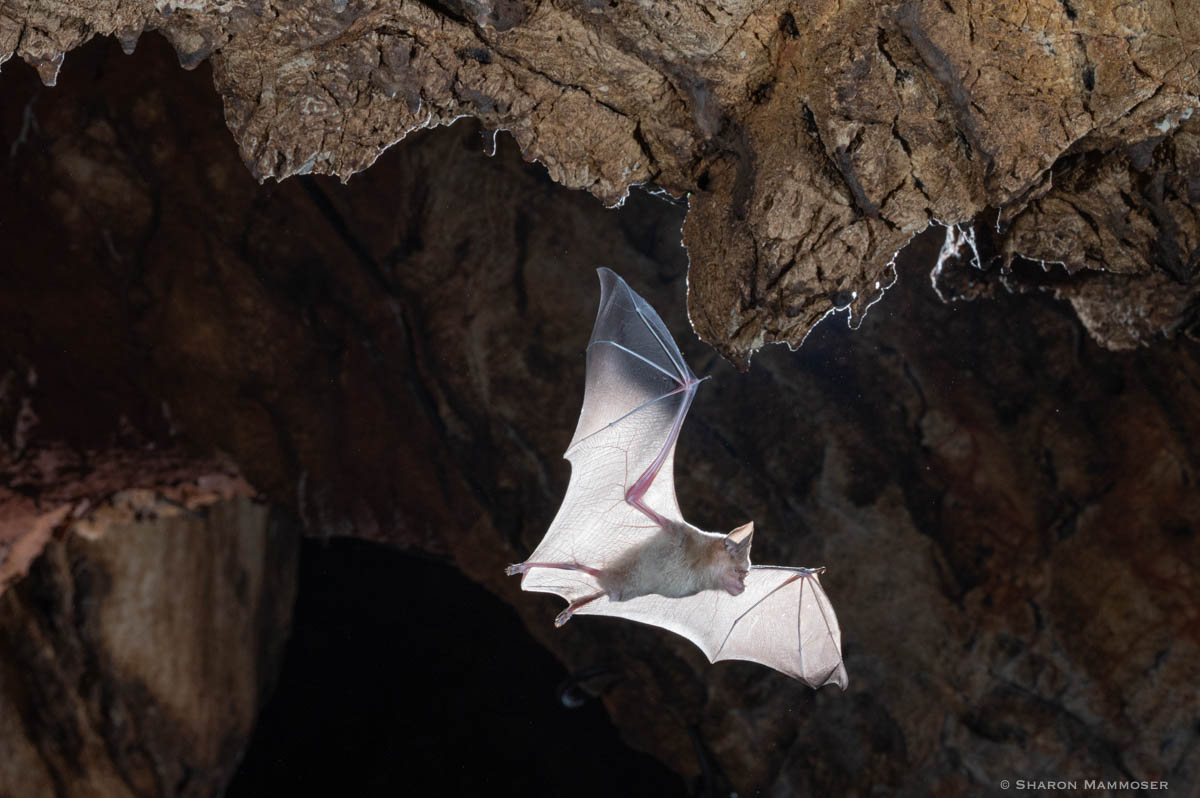
After breakfast we traveled south 200 kilometers to Ratchaburi and our final destination–Khao Chong Phran Cave, located within a Buddhist temple where monks protect this important bat site. This is one of Merlin’s most amazing accomplishments, going back 40 years. At that time Merlin discovered the local people putting up mist nets at the cave entrances, catching thousands of bats each night. They would keep the large fruit bats to sell for food, and kill the smaller insectivorous wrinkle-lipped bats, breaking their necks and discarding them on the ground. The population at this cave numbers in the millions, but was quickly declining because of these practices. Merlin’s intervention through the years has completely changed the way the Thai people operate there and as a result, the population has recovered and is now thriving. Using his philosophy of “Win friends, not battles,” Merlin convinced the people that they could make more money harvesting the bat guano and encouraging tourism rather than killing the bats for food.
Our group arrived at the parking lot far below the cave a little before sunset. We admired the bat statues and listened to Merlin talk about his experiences there, waiting for dark. Merlin and a handful of his staff disappeared up the super steep mountain path to watch from the cave entrance while the rest of us explored the market across the street. There we found vendors selling everything imaginable from fresh fruit to whole pigs wrapped in plastic and waiting to be roasted. As someone who doesn’t believe in exploiting animals for food or other purposes, I quickly realized this wasn’t a place for me and bee-lined it back to the parking lot to wait for dusk and the bat emergence.
When the light was fading we started to see the first bats emerging from the cave on the hillside. They were unorganized at first, the handful of bats scattering in all directions, scoping out the wind direction and other factors we can only guess at. Within minutes the message was communicated and the bats organized, flying in one undulating column that formed a moving tunnel of living, circling bats. Like a tornado, the writhing mass of bats swirled and floated, the long column fading into the distance as more bats came from the cave. Even when it was too dark to see I knew the bats were still above me because I could hear the sounds of their wingbeats in the black. The exit of the colony from the cave took more than an hour, maybe even two. It’s hard to say because by then it was very dark and the air was filled with the incessant whine of hungry mosquitoes I was anxious to escape.
The next day we rose before dawn, heading the short way down the road, back to the cave. Because of Merlin’s long term relationship with the monks, we had been granted special permission to enter the cave and watch the bats return. This might have been the most amazing experience of the entire trip!
In a line of dark figures, we quietly entered the cave, making our way across the uneven rocky surface thick with the pungent guano. In some places it was several inches deep, making our feet disappear in it. Above us, in the dark, we could hear the swirling bats, thousands of wingbeats slicing through the silence. Shining a light above us, we could see their dark bodies circling, all of them returning and looking for “their” spots to roost. The beam of light highlighted hundreds of tiny lights on the cave walls– the eyeshine of thousands of fruit bats already safe inside the cave. To me they resembled fireflies twinkling in the darkness.
At this point some people were anxious to get out of the cave– the thousands of cockroaches crawling on the ground in the guano, and the rats searching for food was too much like a scene from a nightmare and they wanted out! I stayed, choosing to walk farther into the cave, through a passage where climbing over large rocks was necessary to make progress. I continued, heading towards a large opening where I could see light bleeding in from outside the cave. After a while I reached a giant “room” with an opening to the outside world, allowing me to see the bats swirling above me. Several local people–all barefoot– passed me, heading in, or out of the cave, there to collect guano. On their shoulders they hoisted giant 50 pound sacks full of guano– a rich fertilizer they would sell later in the market. Merlin told us they come to the cave once each week, filling sack after sack after sack, returning with each full one several minutes later to go again. They would do this for hours, harvesting guano that they would sell to feed their families.
The next evening a handful of us set up our tripods and cameras at the mouth of the cave. When they started to exit the cave, we were surrounded by dozens of beating wings at a time, all ready to head out into the growing darkness to go hunting up the river. Our cameras snapped photo after photo, hoping to capture them as they flew by us.
The swirling bats flying above me in the cave, and standing at the cave entrance and watching hundreds of bats exiting both amounted to an experience that is hard to put into words. There were hundreds of thousands flying, and hundreds of larger bats already roosting on the cave walls. I could stand alone, surrounded by the walls of this ancient cave, knowing this had been happening for thousands of years, mostly unseen by humans. Being there in Thailand with Merlin made it extra meaningful because it is because of him and his hard work, dedication and philosophy that these bats are protected.
Takeaways
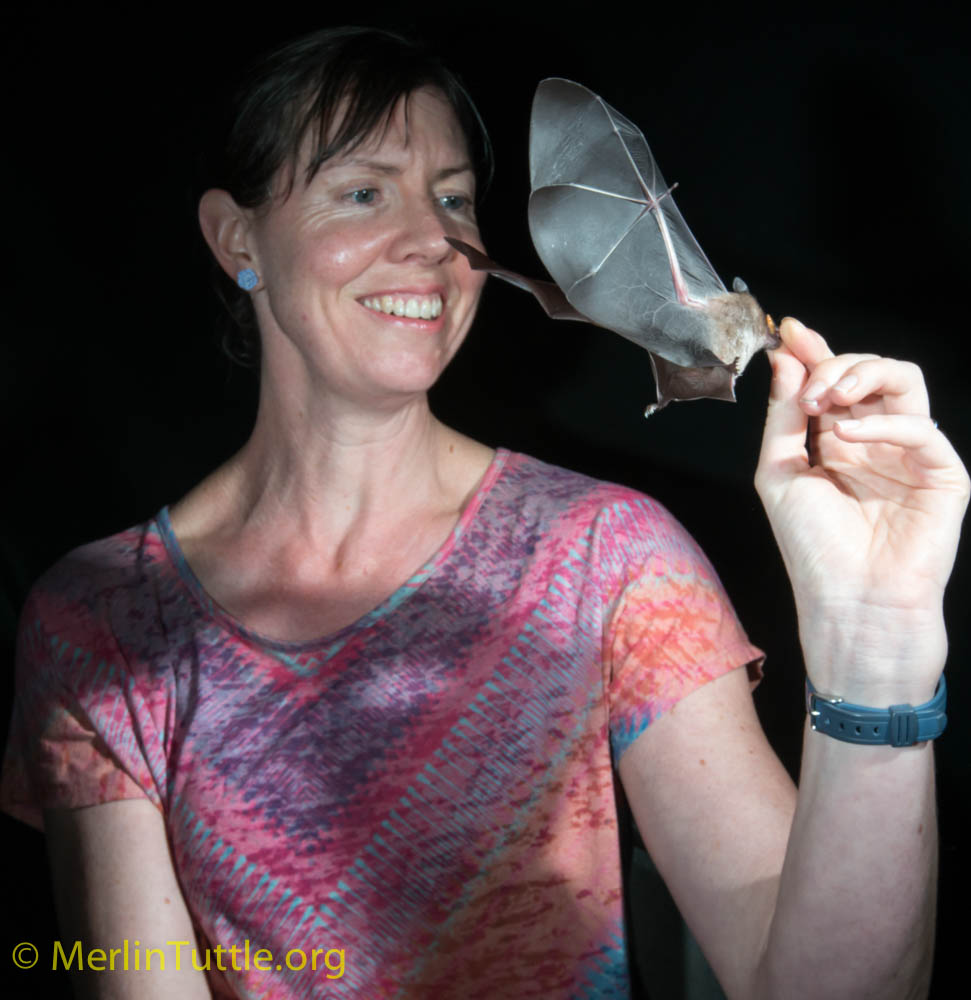
Never handle a sick or injured bat. To handle bats in this Citizen Science Program in Panama and Thailand, taking the rabies vaccination was required.
I have two major takeaways:
The first is that our world has so many amazing things in it, from bats to bees to mushrooms, fireflies, flowers, mountains, rainbows, clouds, cardinals… and on and on. There is an infinite number of incredible creatures, places and things, whether we are in Thailand, North Carolina or elsewhere. Ever go to a museum, pay the entrance fee and then walk around, not looking at one single thing, just hurrying through to get to the end? Life has a way of mimicking that and so many people walk around with blinders on. We must not lose our curiosity! There is so much to learn about and study and watch and experience. Let curiosity in again and see where it leads you.
The second is to JUST DO IT. As you may know my husband died in November. It’s impossible to describe what my life has been like since then. Challenging is the best word I can come up with but that falls very very very short of my reality. When this trip came up I was reluctant to go for many reasons and yes, there definitely were some very low lows during my time traveling. But there were a lot more highs and looking back, I’m glad I went. So next time I’ll remind myself to choose the adventure. I will do it alone. I will do it scared. I’ll do it even though… Plan the thing you’ve been saying forever that you will get to “Someday.” There is no someday. Someday is now. Stop waiting for the stars to align, for the “right time…” The right time is now. Do it now! Do it now, do it now. When was the last time you said yes to an adventure?
Here’s an 18 minute video I created with movies and stills from my time in Thailand. I highly suggest you view this on something larger than a phone, as it’s hard to appreciate the photos in such a small size.
I hope you enjoy it… and more importantly, I hope it lights a fire in you to plan your own adventure, however big or small that might be.
WOW Sharon! What an adventure. All So very interesting. Thanks for sharing 😊.
You’re welcome Helen. Thanks for sticking with me all of these years!