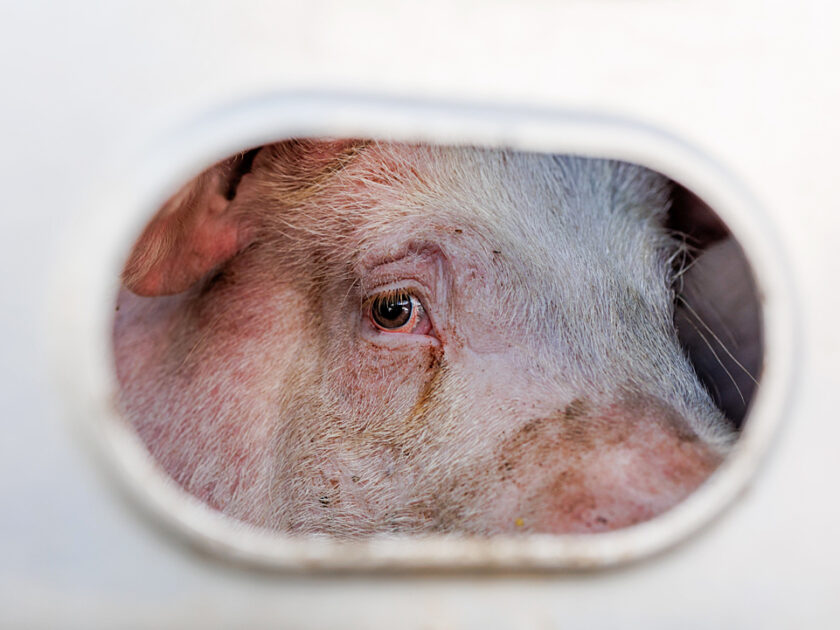
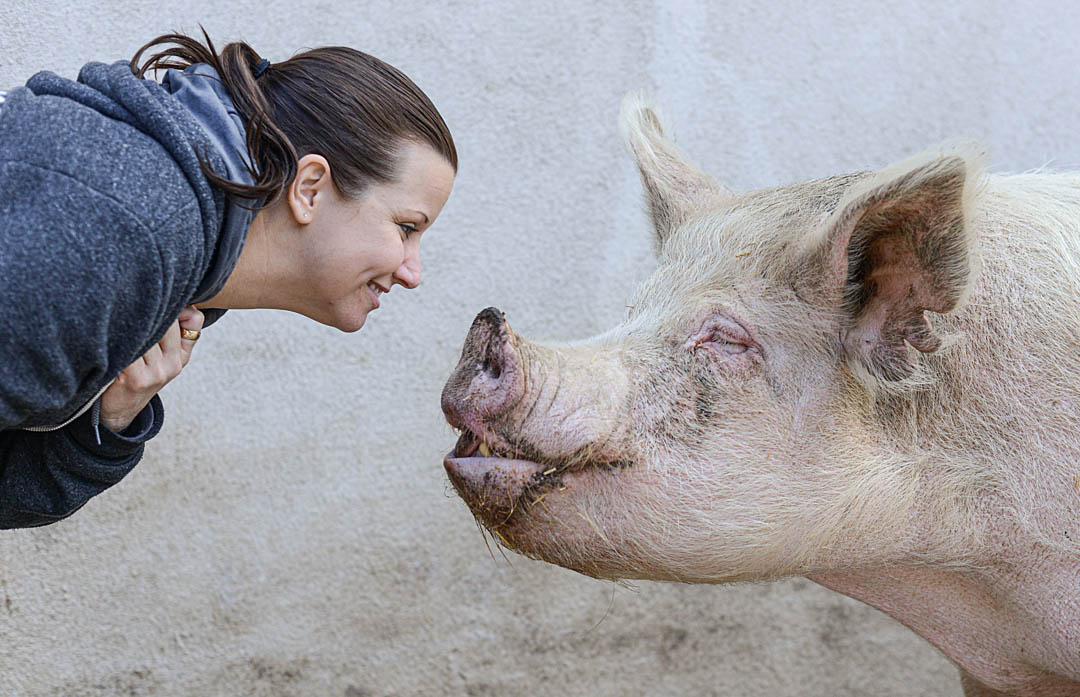
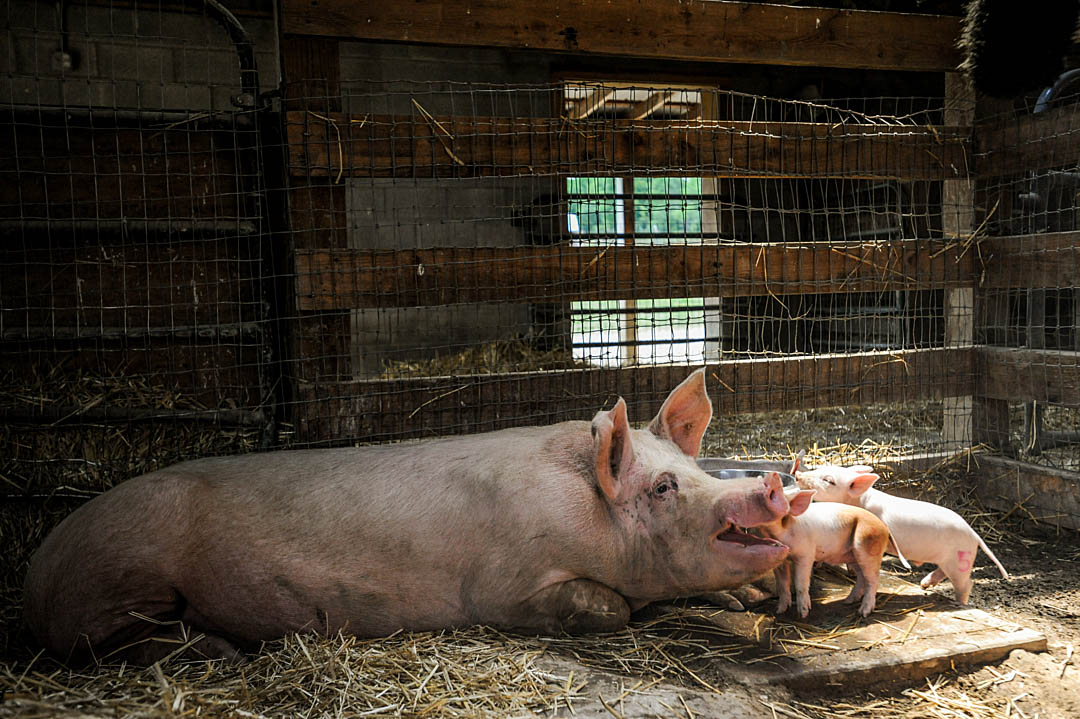
Pigs are gentle, intelligent, social creatures who have complex personalities, and can often out-preform dogs on many learning tests. Pigs have the cognitive ability of a 3 year-old and can recognize up to 20 individuals. Pigs, when given the chance, can live into their teens, are protective of their young, play with toys, and form strong social bonds with other pigs, including having best friends that they enjoy spending time with. As their piglets nurse, mother pigs use different vocalizations to communicate with them, including singing!
Friends at Farm Sanctuary. Acton, California, USA, 2014. Jo-Anne McArthur / We AnimalsJulia, a few weeks after her rescue from a factory farm. She gave birth to 16 piglets at Farm Sanctuary where she lived a peaceful life until she passed away. Farm Sanctuary, Watkins Glen, New York, USA, 2012. Jo-Anne McArthur / We Animals
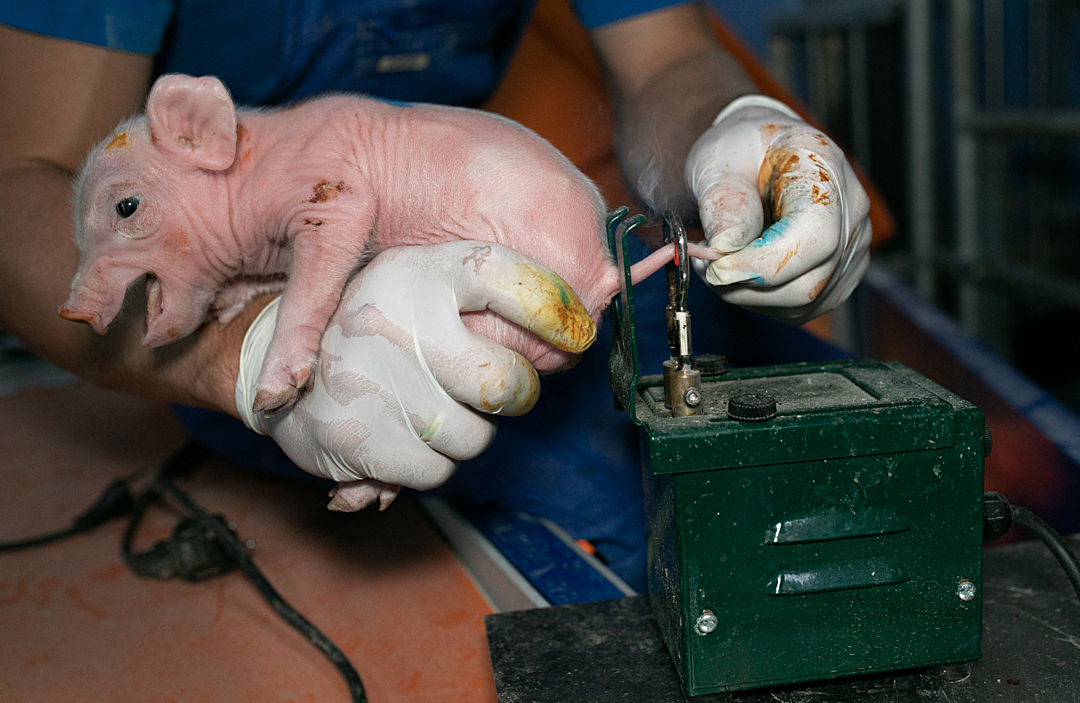
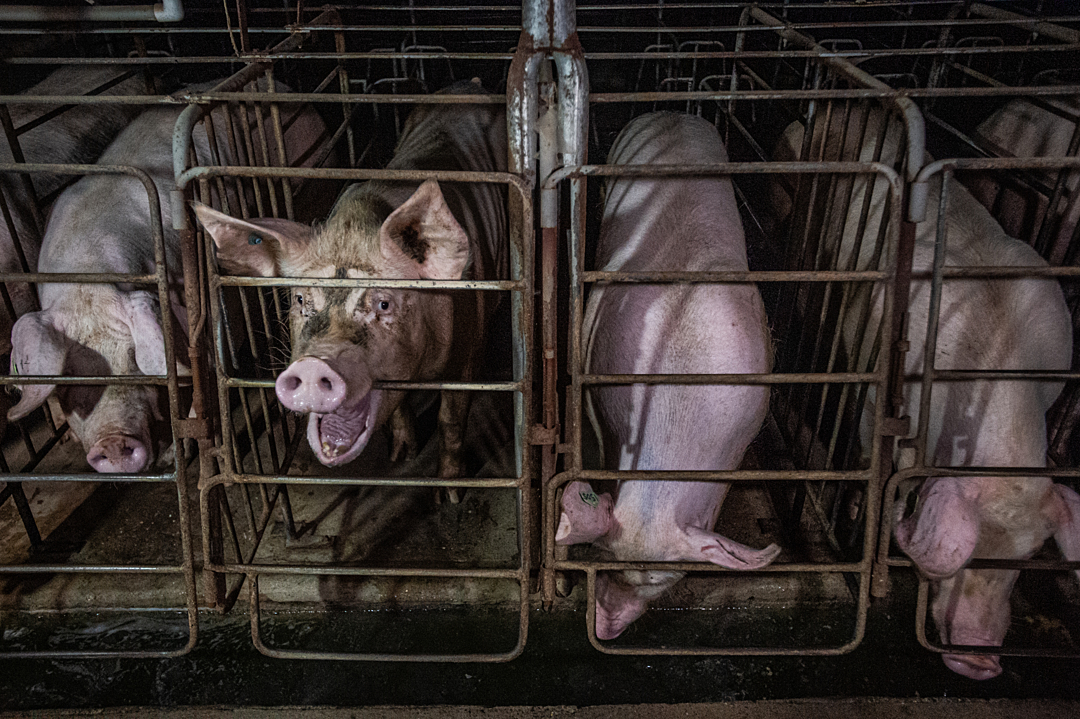
On an industrial pig farm, a sow chews repetitively on the metal bars of her gestation crate while her neighbours drink accumulated water from a channel that runs in front of their enclosures. Sows confined inside these bare, concrete-floored enclosures can sit, stand and lie down, but they cannot walk or turn around. Quebec, Canada, 2022. Jo-Anne McArthur / We Animals A piglet’s tail is cut off by a worker at a factory farm. Andrew Skowron / We Animals
The Facts:
On any given day in the U.S., there are more than 75 million pigs on factory farms, and more than 124 million are killed for food each year.
Nearly 4 million pigs are killed EVERY SINGLE DAY for human consumption around the world. Annually, around 1.5 billion pigs are slaughtered.
Pigs live their entire lives in metal crates (called furrowing crates and gestation crates) that are made of metal or concrete and are usually side by side in large, crowded sheds or barns. They are not able to turn around, lie down comfortably, stretch, stand up fully or socialize with other pigs. They are forced to spend their entire lives on concrete floors.
When Mother pigs are pregnant, they are confined to gestation crates. These severely limit their movements, leading to a life of constant physical discomfort, stress, and deprivation. After giving birth, Mother pigs are moved from furrowing crates to gestation crates, and though the name changes, the situation is equally horrific. Designed to prevent the Mothers from crushing their babies, they are not able to interact with the piglets, move comfortably and freely, or nurse them in a natural way.
Male pigs are castrated –without any pain relief– shortly after birth to prevent an undesirable odor known as “boar taint.” This procedure is carried out using a scalpel, knife, or sometimes even by simply using a pair of clamping instruments to crush the testicles. As per Cruelty.farm, “Following the castration, piglets are often left alone, trembling in pain. It is not uncommon for them to be visibly distressed, unable to stand or walk properly in the days following the procedure. Many piglets will spend the next several days lying motionless or isolated from the rest of their littermates, in an attempt to cope with the trauma. The mental anguish these piglets experience can lead to long-term psychological issues, and some may develop abnormal behaviors due to the stress and pain.”
In addition to castration, pigs are subjected to tail docking, teeth cutting (the ends of their teeth are cut off) and ear notching– all without any pain medicine. Because the pigs are forced to be in such unnatural close quarters, and prevented from engaging in natural behaviors such as rooting, nesting, foraging or socializing, they may exhibit compulsive behaviors such as biting on each other’s tails. Rather than deal with the root cause– too many pigs in too little space– the industry opts for the cruel procedure of cutting off their tails– usually within a few days of being born. As per Cruelty.farm “As a result, pigs experience immediate and excruciating pain, as the tail contains a significant amount of nerve endings… The pain from the procedure can lead to infections, severe bleeding, and long-term health complications. Many pigs will also suffer from phantom pain, as the nerve endings in the tail are severed, leaving them with lingering discomfort that can affect their overall well-being.”
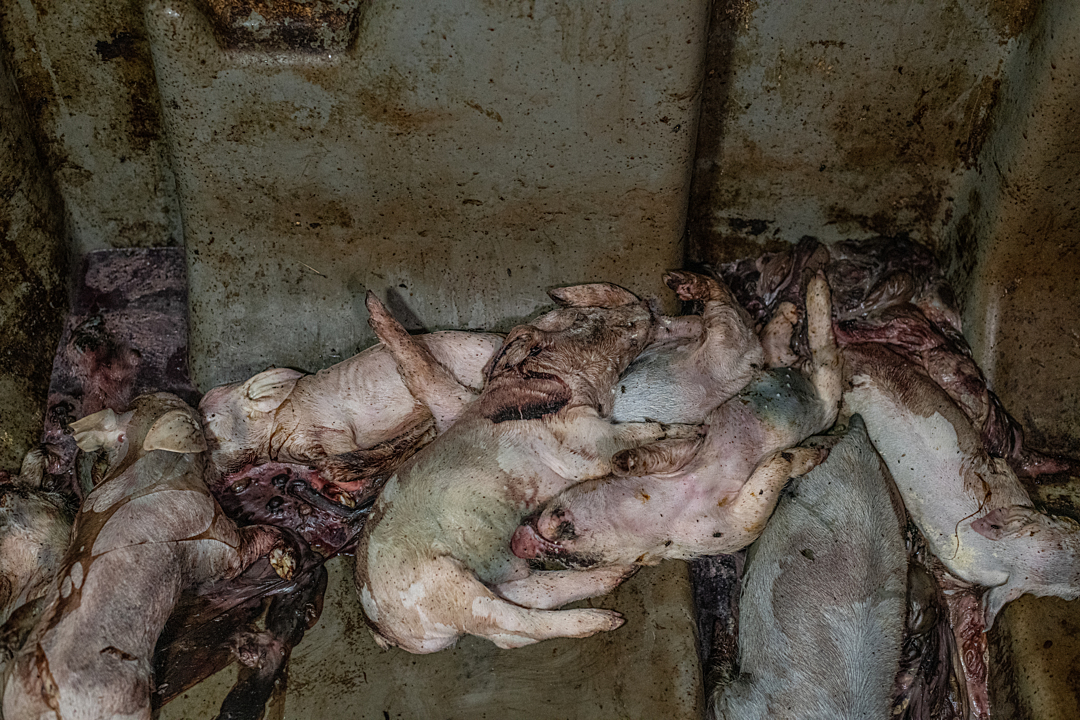
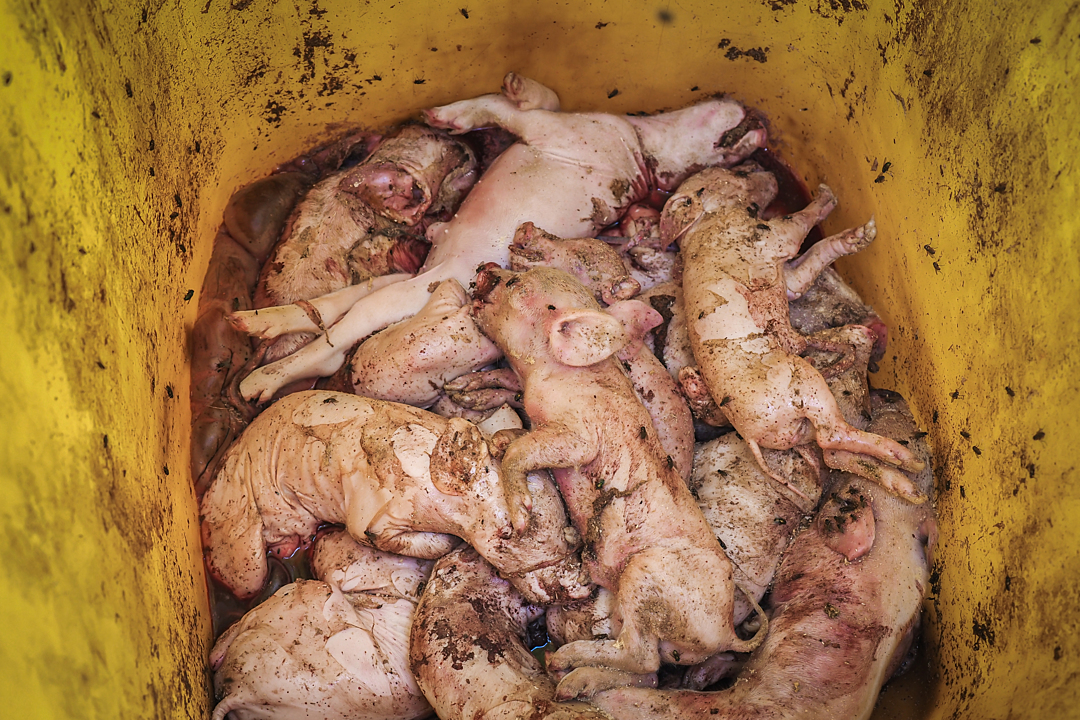
Numerous discarded dead piglets lie in various states of decomposition at the bottom of a dumpster at an industrial pig farm. Quebec, Canada, 2022. Jo-Anne McArthur / We Animals.
As per Cruelty.farm, “In a typical slaughterhouse, more than 1000 pigs are killed EVERY HOUR, creating an atmosphere of intense speed and high-volume production. this fast-paced system prioritizes efficiency and profit, often at the cost of the pig’s welfare. Before slaughter, pigs are supposed to be stunned in order to render them unconscious, but the high speed of the slaughter lines makes it nearly impossible to ensure that every pig is properly stunned. As a result, many pigs remain conscious and aware during the killing process. The stunning process, which is intended to render pigs unconscious and insensible to pain, is often poorly executed, leaving pigs fully aware of the surrounding chaos.
This failure means that many pigs can still see, hear, and smell the horrors happening around them, creating an intense psychological trauma in addition to their physical suffering. Once the pigs are stunned, their throats are slit open, and they are left to bleed out in a terrifying and excruciatingly slow manner. The pigs are fully aware of what is happening, as they continue to struggle and gasp for breath before succumbing to blood loss. This prolonged suffering is compounded by the fact that many pigs are not immediately incapacitated, leaving them in a state of terror, pain, and confusion as they slowly die.”
In pigs, the natural weaning process takes two to three months, but on factory farms, piglets are taken away from their mothers after just three to four weeks.
They are then crowded into metal-barred and concrete-floored pens in giant warehouses where they will live until they are separated to be raised for breeding or meat. More than one million pigs die annually just during transport to slaughter, and as many as 10 percent of pigs are “downers,” animals who are so ill or injured that they are unable to stand and walk on their own.
Meat pigs are kept in extreme confinement until they reach a slaughter weight of 250 pounds, usually at 6 to 7 months of age.
As per Peta, “Clean by nature, pigs on factory farms are forced to live amid their own feces and vomit—and sometimes even amid the corpses of other pigs. Extreme crowding, poor ventilation, and filth lead to rampant disease. By the time they’re sent to slaughter, many farmed pigs are suffering from lung lesions caused by pneumonia. At any given time, more than half of them suffer from mange. And although they’re fed antibiotics to promote growth and prevent disease, many still die of viral infections.”
Some small pigs are killed by a cruel method the industry calls, “thumping.” The baby pig is held by its back legs and slammed into the ground or a wall to kill them. This sometimes takes multiple tries.
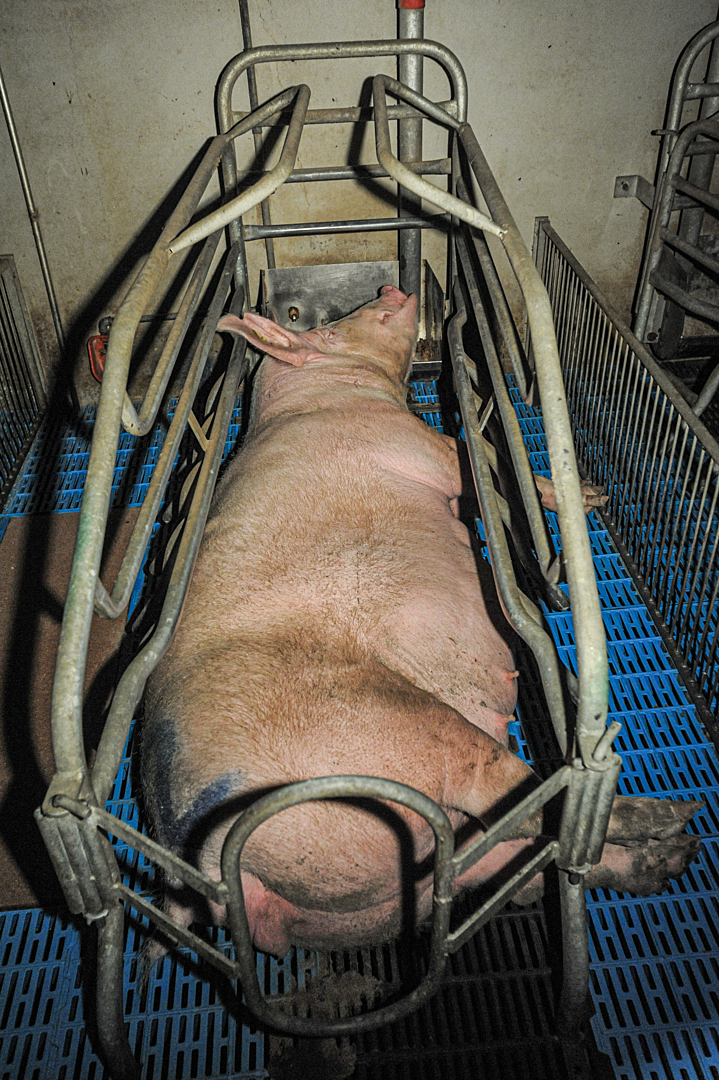
A sow at a factory farm. 2009. Jo-Anne McArthur / Animal Equality / We Animals
According to Animal Equity, “Pigs are bred to grow unnaturally large, generally reaching up to 250 pounds in just six months. Those used for breeding can grow even larger, with many weighing in at 550 pounds or more. This rapid growth is a product of genetic engineering and antibiotic use, along with restricting pigs’ movement in cages. Their unnatural size often causes immobility and other illnesses. ”
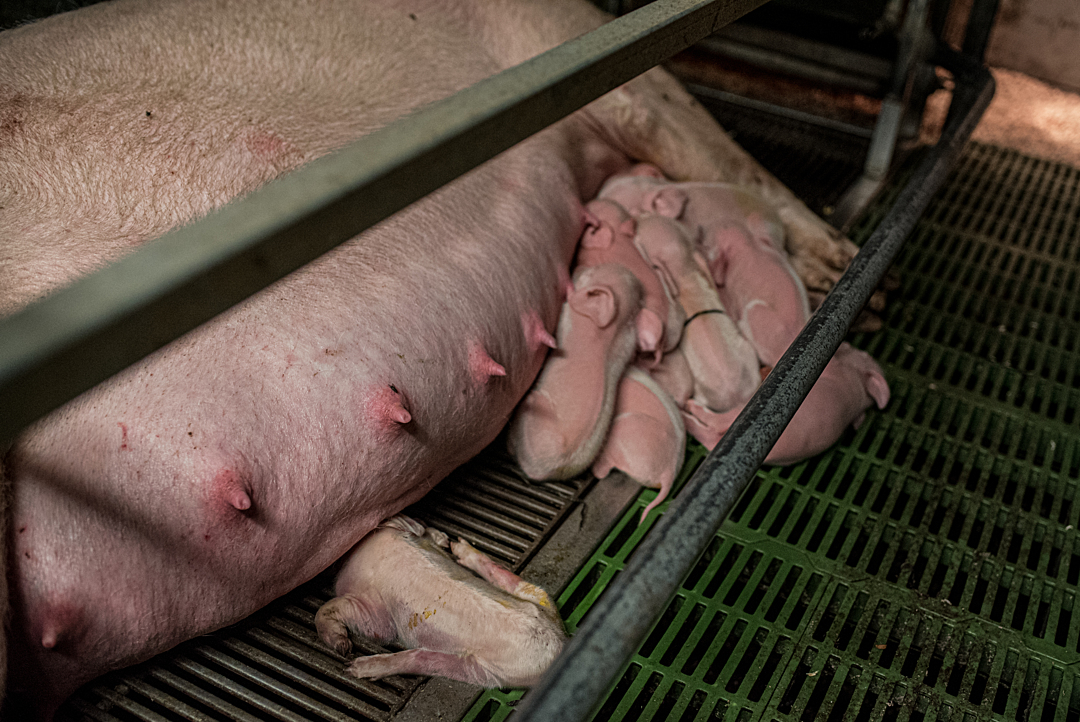
A crushed piglet under his mother’s belly in a farrowing crate. Unable to move except to stand up or lay down, it is common for sows to accidentally crush their babies this way. Italy, 2017. Stefano Belacchi / Essere Animali / We Animals
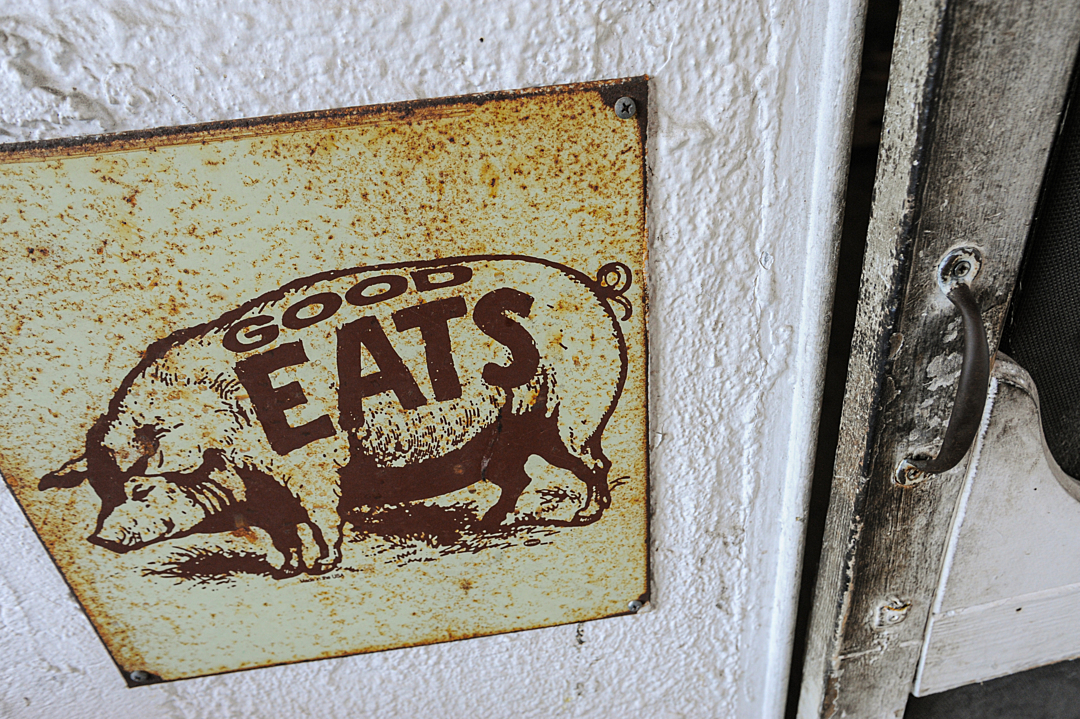
A pig motif with the words “Good Eats” hangs beside a restaurant entrance. Gator Park/Everglades National Park, Miami, Florida, USA, 2011. Jo-Anne McArthur / We Animals
Animal Equity goes on to say, “While the law requires slaughterhouses to stun pigs before slaughter, their methods are often ineffective. In some cases, workers deliver an electric current to the head via a bolt gun. In other cases, pigs are forced into a carbon dioxide gas chamber, where they struggle desperately to breathe and attempt to escape. Pigs are then shackled by one leg and lifted, their throats often slit while conscious. Many feel the pain of the sharp blade and suffer as their bodies are thrown into scalding tanks of water. ”
On an industrial pig farm, a sow chews repetitively on the metal bars of her gestation crate while her neighbours drink accumulated water from a channel that runs in front of their enclosures. Sows confined inside these bare, concrete-floored enclosures can sit, stand and lie down, but they cannot walk or turn around. Quebec, Canada, 2022. Jo-Anne McArthur / We Animals
Flies crawl over the decaying bodies of dead piglets dumped in a trash bin on a pig farm. 2020. Lukas Vincour / Zvirata Nejime / We Animals
Science has proven that there is no reason we need to consume animal products to live a long and healthy life. In fact, it’s just the opposite, as many of these products are actually bad for us, contributing to heart disease, diabetes, some cancers and other diseases.
Choose compassion over tradition, empathy over apathy! Stop consuming pork and pig products. Have the courage to align your values with your actions, instead of supporting this cruelty. Go vegan.